Wednesday, March 19, 2014

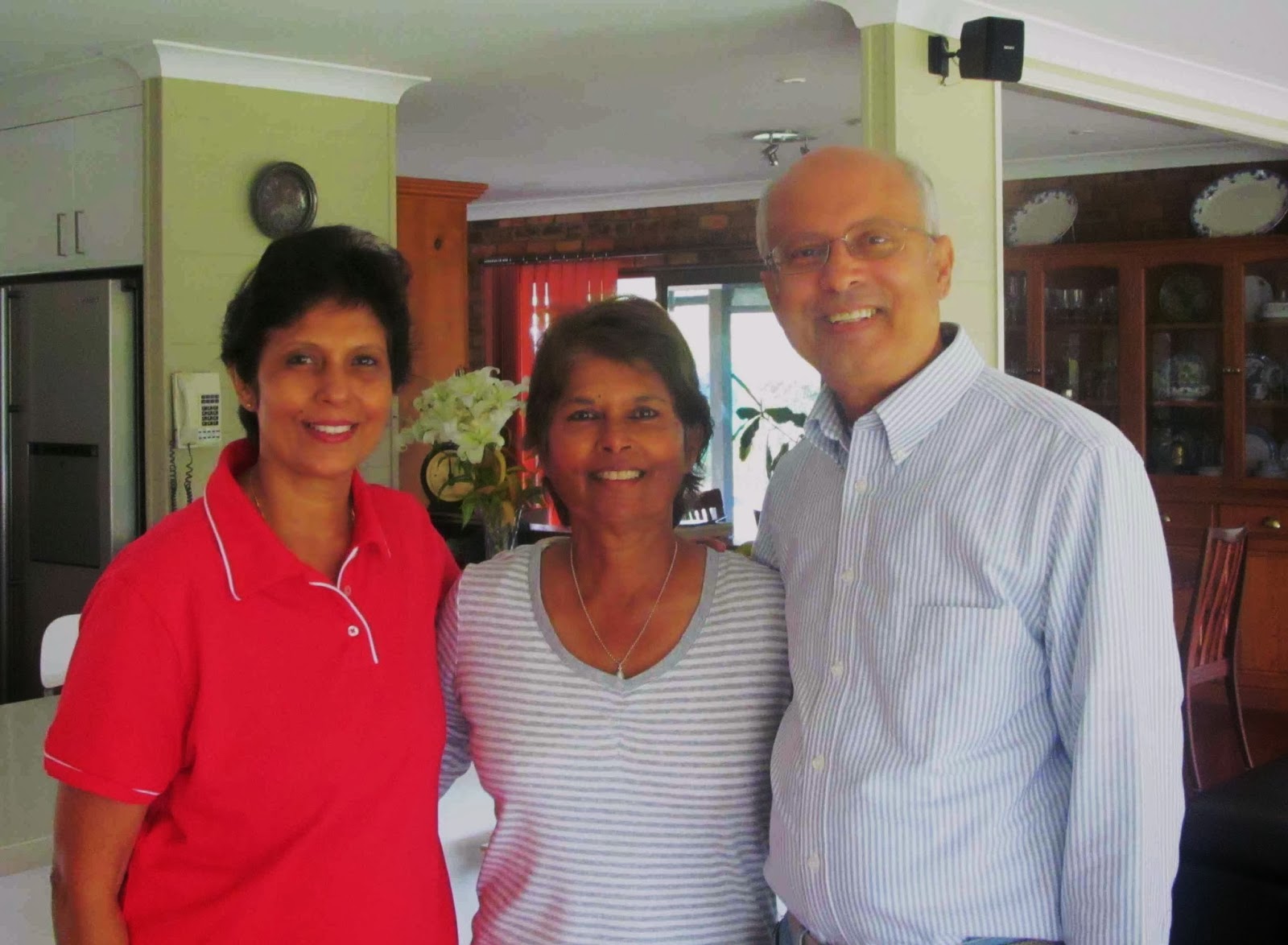
Aunty Alice - 98 on March 2

Celebrated at daughter Heather's home

Cousin Stan and Heather are also in this photo


Wednesday, February 5, 2014

Photos of Ancestors

Adeline Mary Braine (ne'e Becher), wife of great grandfather Charles Frederick Braine

Charles Frederick Braine (great grandfather)

Charles Joseph Braine, great-great grandfather, born 1845. Coffee planter in Ceylon. Also lived in Hong Kong.

Eudora Adeline Mary Braine (1877-1966),  grandfather Charles Stanley Braine's sister. 


Charles Stanley Braine (grandfather)

Eudora Braine (ne'e Marriott), great-great grandfather Charles Joseph Braine's wife


Monday, December 9, 2013

Grandfather Charles Stanley Braine's Passport


Cousin Stanley Braine in Brisbane has the passport.

Wednesday, October 16, 2013

Letter from grandpa Charles Stanley Braine to daughter Alice, 1941


Aunty Alice had saved this letter all these years.

Explanation and Comments

LP at the top right hand corner refers to Lewis Place, on the beach in Negombo. According to Aunty Alice, grandpa stayed every weekend at Miss Carey's guest house in Lewis Place. The guest house was for European Planters.

Grandpa owned a house, "Stanlodge", at Lewis Place, but he may have preferred to stay at Miss Carey's to enjoy the company of Europeans. "Stanlodge" was eventually given to Aunty Amy (Mrs. Chelvaratnam) who sold it before emigrating to Australia.

In the letter, the "Bill" refers to Bill LeMotte, husband of Aunty Kate. Bill owned a farm in Teldeniya.

The mention at the end of page 2 of Aunty and Uncle refers to Mr. and Mrs. Phillips, grandpas' very good friends. Mr. Phillips was a Trustee of grandpa's Will.

In the letter, grandpa leaves specific instructions regarding his funeral.  He says that he "hates the sight of people in black" and requests that his children not dress in mourning. He would like a "quiet and simple funeral, no flowers only a simple bunch of ordinary garden flowers". He says "hope it won't years yet before I pass beyond". In fact, he lived for three more years.

I doubt if grandpa received the quiet funeral he asked for. Going by the account of a Catholic priest who converted him to Catholicism on his deathbed (which I have described in a previous blog entry), his passing may have been traumatic. His children wanted him converted to Catholicism, his good friend Mrs. Phillips put up a tough resistance. As a compromise, although he died a Catholic, he was buried in the Anglican section of the General Cemetery, Negombo, not far from Lewis Place.

The following entry is from by dad's writings:  
"In 1944 my father had to be moved on doctor’s advice to a home close to the sea beach, and he lived in the home of Mr. Grenier at Lewis Place. I used to visit him once a week as he was convalescing. He moved about in the house on a wheel chair, the consequences resulting from a fall from a horse some years back."

Another anomaly. Aunty Alice says grandpa stayed at Mrs. Carey's while my father wrote that grandpa stayed at Mr. Grenier's. 

Actually, the fall may have been from a bullock cart at Mawatte Estate. Great-grandfather Charles Frederick fell off a horse.


Saturday, October 12, 2013

Death and Funeral of Charles Frederick Braine, our great-grandfather, in 1896


From the Times of Ceylon, March 12, 1896

Mr. CHARLES F. BRAINE

We regret to have to announce the death of this gentleman, who, after a long illness, succumbed this morning to the effects of malaria, contracted in Kurunegalla, aggravated by the results of a fall from his horse. The deceased gentlemen, who was the eldest son of the late Mr. Charles Joseph Braine, of China, Ceylon, and London, came out to Ceylon in 1869, and entered the service of Ceylon Company, Limited. He learnt planting on Meddacombra estate, and served the Company in Pussellawa, Badulla, and Dikoya. In the latter district he was well-known and respected, having managed Mannickwatta estate for over 12 years. When that estate was handed over to Mr. F.H.M. Corbet, he entered that gentleman's employ and continued in it until the estates were formed into the Wanarajah Co. He acted for a time on Kondesalla Estate, Dumbara and then accepted the task of opening Delwita estate in Kurunegalla, in Messers. Finlay, Muir, and Co's employ. Here he absorbed the malaria from the effects of which he died. He received injuries in the carriage accident in which Mrs. Braine broke her thigh, and was afterwards thrown from his horse about two months ago. After the fracture to the skull had healed he was removed to Colombo, where in the Cargill's Ward he had the benefit of Dr. Garvin's skill and was most assiduously nursed by Mrs. Braine, but, despite everything that could be done, he sank under his injuries, and died this morning at the hospital at 1 o'clock. The deepest sympathies will be with the widow and orphans of one who had deservedly earned the reputation of being a hardworking, conscientious planter. His remains are to be removed for internment this evening at 5.30.

From the Times of Ceylon 13th March 1896

Funeral of Mr C.F. Braine

The funeral of Mr C. F. Braine took place at 5.30 pm yesterday at the General cemetery. Amongst those who assembled to pay their last respects to the deceased were
Mr S. Braine (son of deceased), Messrs  B. G. L. Bremner, A. C. Courtney, C. Roberts, J.H. Starey, G. W. Carlyon, T.W. Hall, N. Baker, Cameron Smith, Hugh Smith, Duff Tytler, D.G. Mantell, R. John, J. Abel, A.E. Wackrill,  C. Rainnie, E. Benham.

The Rev Mr Ford officiated both at the Mortuary Chapel where the body was in waiting ready to be intered and at the grave which was by the entrance gate.

(The above information was sent to me by Mrs. Maggie Pulle. Thanks, Maggie.)

MY COMMENT

In February, I posted a blog post titled "looking for Charles Frederick Braine" in which I described a futile search that my sister Beaula, brother-in-law Bandara, and I undertook to the Dikoya area to look for the grave of my great-grandfather. The search was the result of an entry in the Kabristan Archives site for tea country graves in Ceylon, which listed Charles Frederick's grave at Dikoya. We didn't find his grave, but found the grave of his infant son at a churchyard in Bogowantalawa.


The mystery of the grave appears to have been solved with the above information. Charles Frederick appears to have been buried in Colombo, at the General Cemetery (Kanatte), which, incidentally, his grandson Stanley Theobald (my father) is buried. 


If Charles Frederick arrived in 1869, he would have been a tea planter.  As a result of the coffee blight, coffee plantations in Ceylon (which covered about 162,000 acres in 1867 and employed about 2000 British planters) had been destroyed and gradually replaced by tea. Charles Frederick's father, Charles Joseph, would have been a coffee planter. 


Charles Frederick moved about, from Pussellawa, to Badulla, to Dikoya, to Dumbara,  and finally to Kurunegala. At the first four locations, he would have been a tea planter. At Kurunegala, more like Matale, he would have cleared the forest to plant rubber. (Delwita Estate is listed as a rubber plantation.) Malaria was rampant in those days and for many, including Charles Frederick, fatal.


Charles Frederick was prone to injury. First, a carriage accident is noted, then a fall from a horse.


Interestingly, only Stanley (Charles Stanley, my grandfather) appears to have attended Charles Frederick's funeral. He had three more children and their presence at the funeral is not noted. (Anyway, only the names of male mourners are noted.)

Thursday, October 10, 2013

Relatives in Australia, September 2013


My sister Beaula and I paid a month-long visit to Australia, to Brisbane, Sydney and Melbourne, visiting friends and relatives. The highlight of the trip was seeing our Aunty Alice, the last of my dad's siblings. Aunty is 97 years now, and appears to be in good health, her mind crystal clear especially when recalling her childhood escapades.

Aunty never tired of anecdotes from her days of growing up in Boralessa. She appears to have been quite a tom boy, but may also have been my grandmother's favorite daughter. Aunty was glad to have Beaula and me to share her stories, because we are familiar with the people and places she mentioned. On one occasion, at cousin Virginia's home, she went on for more than an hour, recalling incidents from her childhood of more than 80 years ago.


This group photo shows Aunty Alice surrounded by Heather (Aunty's youngest), Beaula, Stan, and myself.


With Stan (Stanley Braine) at his place in Brisbane.


Beaula with Maureen, Aunty Alice's oldest.


A group photo at Maureen's home. Her husband Fuad and son are also in the photo.


With Gordon, Aunty Kate's son. He's elusive and apparently makes no effort to keep in touch with the four cousins in Brisbane. They were surprised to learn that he met with us.


With Virginia, Aunty Alice's second daughter. She has the loveliest home we stayed in.


In Melbourne, with some Chelvaratnam cousins, children of Aunty Amy. Lloyd, Ann, and Nagesh. In Sri Lanka, they lived in Negombo before emigrating to Australia.


Monday, October 7, 2013

Mawatte Plantation, where grandpa Charles Stanley Braine was the Manager


Beaula and I recently visited Mawatte Plantation, where my grandfather Charles Stanley Braine served as manager. When his mother died in 1909, grandpa was already at the plantation, and he served till 1944, when he passed away. That means his tenure extended to at least 35 years, a lengthy association by any standard.


Mawatte Plantation was about 700 acres in extent during grandpa's time. Now, due to the government's land policies and also due to being subdivided for distribution among the landless, Mawatte is only 350 acres in extent now, still large by Sri Lankan standards. The plantation is now a livestock farm and is managed by LanLib, a Sri Lanka – Libya joint venture. Perhaps due to the recent turmoil in Libya, Sri Lanka's National Livestock Development Board (NDLB) appears to be in charge now.

According to the current manager, who has been at Mawatte for 35 years, the original bungalow is little changed. The view from the veranda of a large flamboyant tree and a sal tree may be what grandpa enjoyed 80 years ago.


The small office, still with a thatch roof, is nearby. I can only imagine the morning roster, where the Tamil labourers would line up to be counted "present" each morning and to be assigned to their work for that day. At the end of the week, around noon on Saturday, they would line up again to collect their wages. Grandpa did not speak Sinhala. He spoke Tamil, a legacy of his upbringing in tea plantations (where the labourers were Tamil). At Mawatte, too, the labourers were Tamil, somewhat unusual for a coconut estate. Even today, many employees at Mawatte farm appear to be Tamils.

Most Europeans in Ceylon were tea or rubber planters. I thought grandpa must have been one of the pioneer European planters on coconut estates. His father C.F. Braine (my great grandfather), towards the end of his life, was a planter at Delwita Estate near Kurunegala, in what appears to have been a rubber estate.

Mawatte is only a 10-minute drive from Boralessa, where I have a home, "Pondside". My Aunt Alice, who is 97, remembers walking from Boralessa, where my grandmother lived, to Mawatte to have lunch or dinner with grandpa. She accompanied grandmother.

The copra (dried coconut kernels) produced at Mawatte Estate were transported to Colombo via the nearby Dutch canal on "padda" boats, which have been described as "flat-bottomed boats with removable roofing " often of "cadjan" or dried coconut palms. My father remembered traveling overnight on a “padda” boat and waking up to see the Victoria Bridge on the Kelani River.


The "captain" of the padda boats that transported copra from Mawatte Estate to Colombo was one Fonseka. His son, Basil Fonseka, was a close friend of my father. As a result, Basil Fonseka became my god father. (My god mother was Aunty Bee.)

More on estate life from my dad Teddy Braine's reminisces

We children didn’t live on the estate, but I recall the family visiting daddy in the estate during school holidays. He had a lovely garden with flowers and fruit trees. Meals were served at a vast dining hall with large table with the Appu at hand serving. At night, the place was lit by Petromax and kerosene lamps, there being no electricity at the time. There was no radio either, and music was played on the gramophone. On warm days, during meals, Appu would stand at the end of the dining hall and pull a rope which was connected to a large canvas curtain hung above the table, swinging the “punkah” to fan those seated at the table.

At the estate, the mornings were always welcomed to the sound of coconuts being cracked for drying in the copra kiln. We would go there to eat the young kernel of the cut nuts. The fragrant smell of copra drying in the two kilns on either side, with rows of coconut shells burning underneath, always held an enchanting spell which any child would envy.